A Shopaholic’s Slapback Guide to Black Friday Sales
10 Nov 2026
A SHOPAHOLIC’S SLAPBACK
For many businesses, Black Friday is a high-stakes opportunity to drive sales, attract new customers and capture market share. But before you slash prices, pour money into social media campaigns and send those glossy sale posters to print, make sure your promotional claims can withstand more than a passing glance.
Don’t get me wrong. I make no secret of being a marketer’s dream. I’ll open the promotional email, follow the pop-up, click through the sale banners and have Apple Pay ready before you’ve had time to say “limited-time offer”.
In my opinion, Black Friday is a win-win. I want the bargains, the excitement and the opportunity to support businesses I love! But even I have started noticing the increasing use of inflated “was” prices, discounts that seem to exclude half the product range and disclaimers so small you’d need a magnifying glass to read them.
And that is where the trouble can start. A promotion designed to drive sales can quickly become a consumer law problem if the headline promise does not match the reality. Getting your pricing, advertising and promotional claims right is essential to making the most of the sales opportunity while avoiding regulatory scrutiny, financial penalties and reputational damage.
This article builds on our previous insights into Black Friday compliance risks and recent Australian Competition and Consumer Commission (ACCC) enforcement activity from November 2025 and May 2026.
Today the ACCC has announced a further Black Friday and Cyber Monday compliance sweep, signalling continued scrutiny of promotional and advertising practices across multiple retail sectors. Notably, the ACCC has confirmed that this year’s review will examine advertising across websites, emails and social media, and will assess whether retailer compliance has improved following enforcement action taken in recent years.
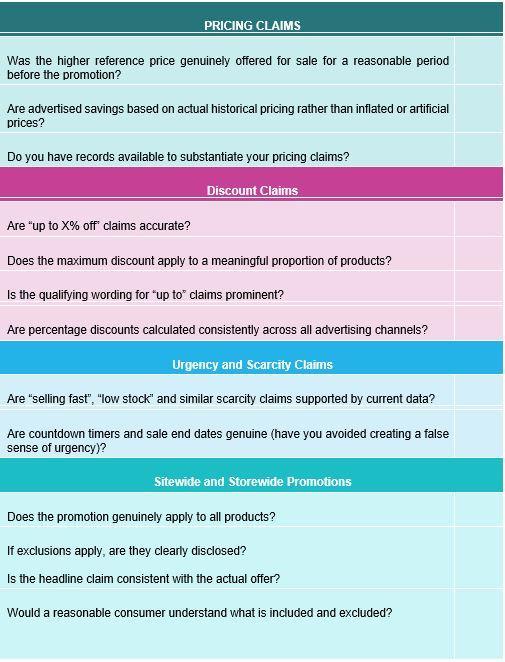
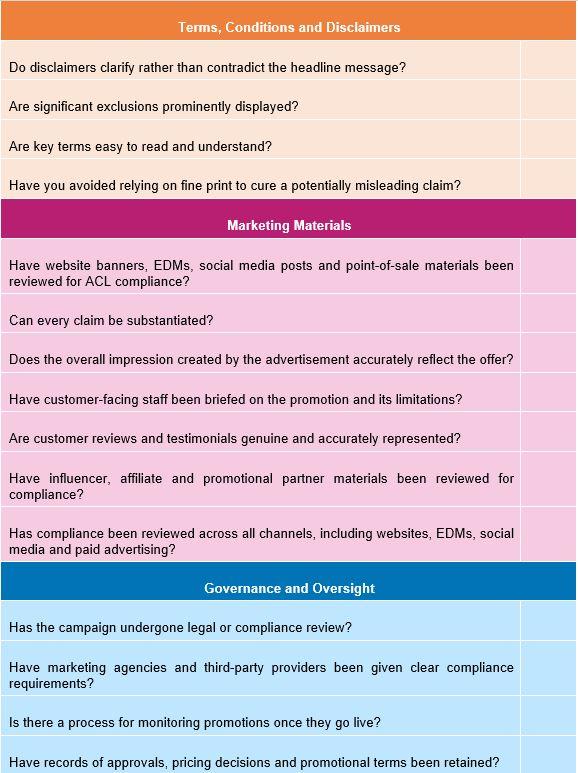
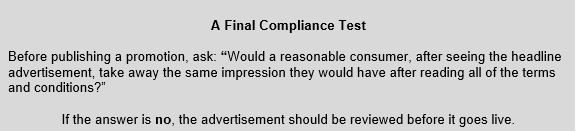
This season, however, we are looking at some common consumer law traps, the real-world examples that bring them to life and, importantly, a practical Black Friday Guidance Checklist to help you put your own campaign to the test before it goes live.
Businesses should also be aware that scarcity messaging is often generated automatically through third-party marketing tools, inventory systems or e-commerce plugins. The fact that a claim is automatically generated does not remove responsibility for ensuring that it is accurate.
Think of it as a reality check (or “reality cheque”) from your favourite consumer. Because a successful promotion should boost your bottom line, not your legal exposure.
THE “WAS” PRICE THAT WASN’T
One of the most common promotional techniques is “was/now” or strike-through pricing. These advertisements compare a product's previous price with a discounted sale price and imply that consumers are making a genuine saving.
Consumer law issues arise where the higher “was” price was rarely, or never, charged before the promotion commenced. In those circumstances, the represented saving may be illusory.
The ACCC’s action against digiDirect for misleading strike-through pricing claims resulted in $99,000 in penalties. Among the products examined was a mini wireless keyboard advertised at $149, reduced from $229, despite the higher price having been used rarely, if at all.
Lessons for businesses:
- Ensure the “was” price reflects a genuine price at which the product was offered for sale for a reasonable period before the promotion
- Avoid inflating historical prices to create the impression of larger discounts
- Consider whether consumers would realistically have purchased the product at the higher advertised price immediately before the sale
Maintain records substantiating pricing claims, as the ACCC is authorised to request evidence supporting advertised savings
The reality cheque: If a customer had walked into your store or visited your website the day before the sale, could they genuinely have purchased the product at the advertised “was” price?
If the answer is no, the pricing claim may be difficult to justify.
THE ILLUSION OF A DISCOUNT
“Up to 50% off” is a powerful marketing message. It creates excitement, attracts attention and gives customers a reason to click through. But what happens when only a handful of products are actually discounted by 50%, while the rest are discounted by 5% or 10%?
Or when a sale advertised as ending at midnight continues for another week? Countdown timers are designed to encourage customers to act quickly. But if the clock reaches zero and the same deal continues, the urgency may be more marketing theatre than reality.
The issue is not necessarily the use of “up to” or limited-time offers. It is whether the overall impression created by the advertising accurately reflects the promotion customers will encounter.
For example, the ACCC raised concerns about Black Friday promotions run by trampoline retailer Vuly, which advertised discounts of “up to 45% off” accompanied by countdown timers indicating that the sale was ending. However, the same or greater discounts reportedly continued after the advertised deadline, creating concerns that consumers may have been misled about the urgency of the offer.
Lessons for businesses:
- Make sure “up to” discount claims accurately reflect the discounts available across the product range
- Ensure the maximum discount is not so limited that the headline creates a misleading impression about the overall promotion
- Ensure countdown timers, sale end dates and limited-time offers reflect genuine deadlines
- If the promotion is extended, review how that extension is communicated
The reality cheque: If customers knew exactly how many products were discounted by the maximum amount, and how long the promotion would actually run, would they still interpret your headline in the same way?
The question is not simply whether the words are technically correct, but whether consumers are likely to take away an inaccurate impression about the nature or duration of the offer.
IS THE SCARCITY REAL?
Black Friday promotions frequently rely on urgency to encourage consumers to act quickly. While genuine scarcity can be an effective marketing tool, businesses should exercise caution when using claims such as “Only 3 left”, “Selling fast”, “Low stock”, “Limited availability” or website prompts indicating that large numbers of customers are viewing a product.
In its 2026 Black Friday sweep, the ACCC specifically identified scarcity messaging as an area of focus, including claims suggesting stock levels are low when they are not. These representations can create pressure to make an immediate purchase and may be misleading if they are inaccurate, exaggerated or unsupported by available evidence.
Lessons for businesses:
- Ensure low-stock alerts and inventory claims are based on real-time or current inventory data
- Review automated website prompts and marketing tools that generate scarcity messages
- Verify that claims can be substantiated
- Retain records supporting stock-level representations and availability claims
The reality cheque: If a customer asked how you knew the item was “Almost sold out” or “Selling fast”, could you demonstrate the factual basis for the claim?
DOES “SITEWIDE” ACTUALLY MEAN SITEWIDE?
“Everything must go!” and “storewide sale” are the sorts of messages that make customers stop scrolling. However, if certain brands, products, sale items or categories are excluded, but the headline suggests everything is included, customers may be left with a very different impression from the offer actually available.
The ACCC has taken enforcement action against several retailers over Black Friday promotional claims, including Michael Hill for its advertised “25% off sitewide” despite certain products being excluded.
Lessons for businesses:
- Only use “Sitewide”, “Storewide” Or “Everything on sale” if the promotion genuinely applies across the relevant range
- If exclusions apply, make them clear and prominent
- Consider more accurate alternatives, such as “25% off selected products” or “Up to 50% off participating products”
- Review promotional materials from the perspective of a consumer rather than from a technical legal perspective
The reality cheque: If you advertise “25% off sitewide”, would a customer reasonably expect the product they are interested in to be included?
If the answer is yes, but it isn’t, your headline needs another look.
DON’T HIDE BEHIND THE FINE PRINT
It is a common misconception that qualifications buried in terms and conditions will protect them from liability. In many cases, this is not correct. Disclaimers may not cure a misleading headline where the primary message of the advertisement creates a false impression.
The ACCC has repeatedly emphasised that fine print cannot be used to contradict the overall impression created by an advertisement. As the ACCC notes, consumers are not required to search exhaustively for qualifications and exclusions. Businesses must clearly draw attention to material conditions so consumers can make informed purchasing decisions.
“Businesses are legally obliged to accurately describe their sale offers and should not use small point disclaimers or terms and conditions to disguise the real extent of their offers” - ACCC Deputy Chair Catriona Lowe.
Lessons for businesses:
- Ensure disclaimers clarify promotional offers rather than contradict them
- Make significant limitations and exclusions prominent. Don’t hide material exclusions in lengthy terms and conditions or use font sizes that are difficult to read
- Ensure important disclaimers are available and not just displayed briefly or via rapid or unclear voiceovers
- Consider the overall impression created by the advertisement as a whole
The reality cheque: Would a customer understand the important limitations of your promotion without having to go searching for them?
If not, your disclaimer may not be doing the job you think it is.
ARE TESTIMONIALS TELLING THE FULL STORY?
As consumers increasingly rely on ratings, reviews and influencer content to make purchasing decisions, businesses should take care to ensure that customer endorsements are presented fairly and accurately.
Th ACCC’s 2026 Black Friday compliance sweep specifically identifies misleading testimonials as a focus area. Reviews and testimonials should reflect genuine customer experiences and should not be manipulated, fabricated or presented in a manner that creates a misleading impression about a product or promotion.
Particular care should be exercised where businesses selectively highlight favourable feedback while suppressing or omitting material information that may alter the overall impression consumers receive.
Lessons for businesses:
- Ensure testimonials and reviews are genuine and capable of substantiation
- Avoid creating a misleading overall impression through selective publication of reviews
- Review influencer and affiliate marketing content for compliance with the ACL
- Ensure endorsements accurately reflect the product, service or promotion being advertised
The reality cheque: If consumers looked beyond the testimonials featured in your promotion, would the broader customer feedback tell the same story?
If the answer is no, the promotion may be creating a misleading overall impression about the product, service or customer experience.
The ACCC’s latest compliance sweep demonstrates that enforcement attention extends beyond traditional discount claims. Businesses should review the full customer journey, including websites, emails, social media, testimonials, inventory representations and automated marketing tools, to ensure that the overall impression created by a promotion is accurate and substantiated.
BLACK FRIDAY COMPLIANCE CHECKLIST
This article was written by Ariel Bastian, Special Counsel, Corporate Commercial.