Excluding members? Not without representation: Lessons from Wintawari Guruma Aboriginal Corporation and Registrar of Aboriginal and Torres Strait Islander Corporations [2025] ARTA 1900
12 Jul 2026
The decision in Wintawari Guruma Aboriginal Corporation RNTBC and Registrar of Aboriginal and Torres Strait Islander Corporations is an important reminder for Registered Native Title Bodies Corporate (RNTBCs) when reviewing or updating their membership rules under the Corporations (Aboriginal and Torres Strait Islander) Act 2006 (Cth) (CATSI Act). The case considered whether a corporation could adopt a rule in its rule book preventing a former member from reapplying for membership for a set period after their membership had been cancelled for serious misconduct.
The case at a glance
Wintawari Guruma Aboriginal Corporation RNTBC (WGAC) had adopted a rule preventing a person from reapplying for five years if their membership had been cancelled for behaviour that significantly interfered with the corporation’s operations.
The Office of the Registrar of Indigenous Corporations (Registrar) deemed the five-year exclusionary period to be non-compliant with the CATSI Act and sought to remove it from the WGAC Rule Book. WGAC sought review of the Registrar’s decision, bringing the matter before the Administrative Review Tribunal (Tribunal).
The Tribunal affirmed the Registrar’s decision to remove the rule, finding it was inconsistent with the CATSI Act because the WGAC Rule Book did not provide any way for a common law holder to be indirectly represented during the exclusion period as required by the CATSI Act.
The Tribunal’s Position
Representation must be available to all common law holders
Section 141‑25(2) of the CATSI Act requires RNTBC rule books to include membership eligibility rules that ensure all common law holders are represented: either directly (as members) or indirectly (through another member).
The Tribunal found that the WGAC Rule Book only provided for direct membership only. Without an indirect representation mechanism, a five‑year exclusion meant a common law holder would not be represented at all.
Exclusion periods are only workable if indirect representation is provided
The CATSI Act allows corporations to cancel membership for serious misconduct. However, if an RNTBC wishes to prevent a common law holder from being readmitted as a member for a period of time, the constitution must also include a clear and workable pathway for indirect representation during that period.
Indirect representation is flexible
The Tribunal noted that indirect representation does not require a close personal link. It may be through a family member, spokesperson or other appointed representative. What matters is that the rule book provides a mechanism that ensures the person’s interests as a common law holder can still be represented.
Rule books must align with native title obligations
RNTBCs act on behalf of common law holders under the Native Title Act and an RNTBC’s regulations and membership rules must operate consistently with that broader framework. The Tribunal emphasised that representation is central to the role of an RNTBC.
Practical considerations for RNTBCs
Corporations reviewing their rule books may wish to consider:
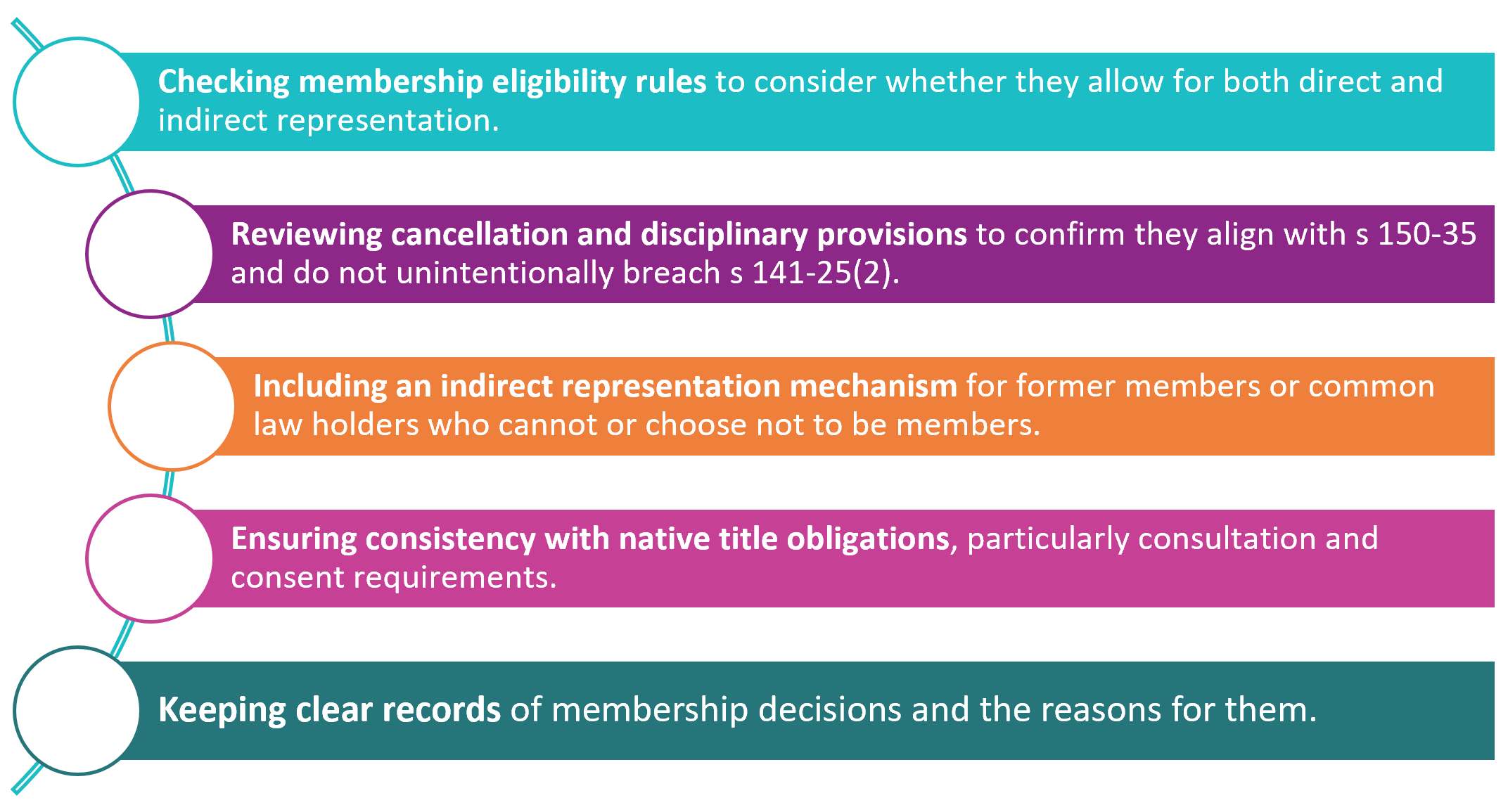
Many RNTBCs continue to face challenges balancing the need to manage conduct matters with the requirement to ensure all common law holders are represented. This decision confirms that exclusion periods can be used, but only where the rule book also provides a practical and workable form of indirect representation.
For RNTBCs considering similar rule changes, the key takeaway is straightforward: any exclusion must be paired with a mechanism that ensures the member interests of a common law holder remain represented within the corporation.
Assistance from Jackson McDonald
Jackson McDonald’s experienced team can provide advice and assistance on reviewing rule books, designing compliant membership provisions and ensuring your governance framework aligns with CATSI Act requirements.
If you would like more information or assistance, please contact Emma Chinnery (Partner) or Nisali Pallewela (Lawyer).
[2025] ARTA 1900 (23 September 2025)