Gas reforms: pipeline access, information reporting and regulatory funding
02 Nov 2026
The Department of Energy and Economic Diversification (DEED) is progressing WA gas reforms covering pipeline access and commercial disclosures, and regulatory funding. These two workstreams have separate consultation stages.
1. What's under development
Gas Pipelines Package: WA proposes to adopt the Gas Pipelines Package and the Other Gases Package, which have been adopted in other Australian jurisdictions.
- The Gas Pipelines Package abolishes “light regulation” as a category of economic regulation, introduces additional transparency and information disclosure requirements, extends regulatory oversight to stand-alone compression services and gas storage facilities and expands the Economic Regulation Authority’s (ERA) functions.
- The Other Gases Package extends the regulatory framework to hydrogen, biomethane and other renewable gases and extends the regulatory framework to blending processing facilities within the regulatory framework.
Regulatory funding: a separate consultation considers recovery of regulatory costs in relation to the functions of the ERA and the Gas Disputes Arbitrator.
2. Overview
The Gas Pipelines Package
The package amends the National Gas Law (NGL), regulations and National Gas Rules, replacing full, light and non-scheme regulation with two categories: scheme and non-scheme pipelines.
The Australian Energy Market Agreement provides the intergovernmental foundation; legislation and rules give the framework legal effect. South Australia is the lead legislator for the NGL. WA applies a modified access-focused framework, while broader retail and gas information arrangements remain under separate WA legislation. National amendments apply in WA only through specific adoption.
Understanding the legal instruments
- National Gas Law and National Gas Access (Western Australia) Law: the national substantive law and its modified WA version, the NGL(WA).
- National Gas Access (WA) Act 2009: the WA application Act that gives the modified national law effect here. Under section 7A, the Minister declares relevant South Australian amendments for adoption. Section 7B allows consequential modifications through regulations amending Schedule 1 of the application Act.
- Regulations: subsidiary legislation supporting the Law. WA uses its own regulations to implement relevant national changes and deal with local matters.
- National Gas Rules: legally binding detailed requirements made under the Law, including access arrangements, negotiations, disputes and reporting. WA has its own version, the NGR(WA).
Scope of WA implementation consultation
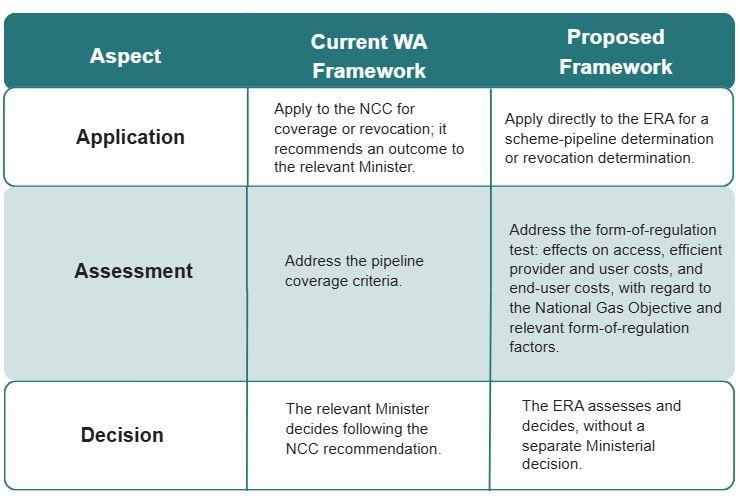
This is not simply the same coverage application sent to a different authority: both the decision-making process and assessment framework change. The ERA could also initiate a review itself.
The package would strengthen disclosure, requiring providers of scheme and non-exempt non-scheme pipeline services to prepare, publish and maintain service and access information, standing terms, financial and historical demand information, cost allocation methodologies and actual prices payable information.
Contractual pricing disclosures would include service characteristics, quantities, duration, price structure and escalation mechanisms, providing context for comparison rather than merely a headline tariff. Targeted exemptions would remain available and will continue to be administered by the ERA.
Changes to scheme-pipeline procedures include a fast-track option and measures to assist small shippers.
3. Implications for pipeline operators
New projects should assess the applicable regime and availability of green fields incentive or price-protection determinations.
Existing pipelines transition according to their current status and transitional provisions.
Full regulation: pipelines such as the Dampier to Bunbury Natural Gas Pipeline would remain scheme pipelines without a fresh coverage application.
Light regulation: the Kalgoorlie to Kambalda Pipeline, WA’s only light-regulation pipeline, would become non-scheme.
Non-scheme pipelines: existing non-scheme pipelines generally retain that status, subject to the revised framework and later ERA determination or provider election.
Capacity expansions would form part of the same pipeline for regulatory purposes; geographic extensions are dealt with separately. Existing GGP capacity is subject to the options below. Operators should review existing reporting exemptions against the new requirements and transitional provisions.
4. Goldfields gas pipeline transition
The GGP currently has scheme and non-scheme capacity on the same infrastructure. DEED seeks views on two transitional options:
- Option 1: national transitional provision
Existing uncovered expansions would become scheme capacity on commencement and enter the next access arrangement proposal, with one access arrangement following the ERA’s decision, not necessarily an immediate reopening of the current arrangement.
- Option 2: WA-specific transitional provision
The current scheme and non-scheme portions would be retained under transitional arrangements.
Existing non-scheme capacity would join the scheme pipeline when an ERA scheme pipeline determination or service-provider election takes effect. A further rule change may be needed to ensure that the consolidated capacity is included in one access arrangement regardless of when that occurs.
The distinction affects tariff oversight, disclosure, dispute pathways and review timing and costs: Option 1 brings existing uncovered capacity into full regulation through transition; Option 2 retains non-scheme status pending a determination or election.
5. Storage and stand-alone compression reporting
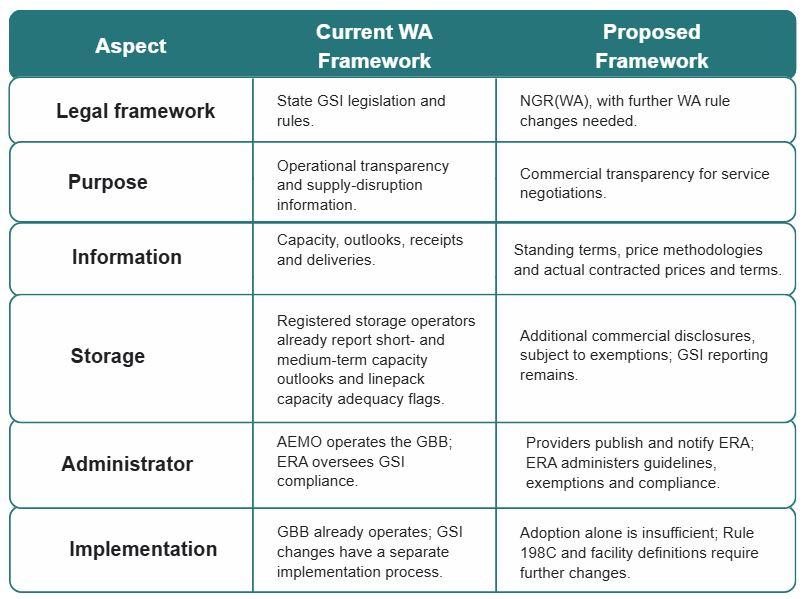
Proposed Part 18A of the NGR(WA), would add commercial disclosures for gas storage and stand-alone compression services. Storage disclosures would complement existing State gas operational reporting, not replace it. Facility definitions, registration and exemptions must be assessed separately under each regime.
The package paper explains that WA has not prescribed any designated compression service facilities, so that category would not attract the obligations. Stand-alone compression service facilities are a separate category; whether a facility is captured must be assessed against the applicable definitions and exemptions.
Providers would publish and maintain standing service terms and standing-price methodologies, plus actual contracted prices payable and relevant terms and conditions, allowing users to compare offers and contracted pricing. Providers would notify the ERA of publication and give it a copy.
The ERA would administer price reporting guidelines, exemptions and their variation or revocation, a public exemption register, and compliance. This is reporting oversight, not approval of service prices.
WA’s GBB operates under the Gas Services Information Act 2012. The national bulletin board provisions remain postponed under section 20A of the NGL(WA); Rule 198C links Part 18A’s application to activation under that section. Adoption through the proposed WA instruments would not, by itself, make Part 18A operative in WA; the proposal to enable it is a separate implementation step.
Subject to consultation, WA proposes an AEMC rule change removing Rule 198C and addressing facility definitions without operative effect in WA. If made, Part 18A could operate alongside the State GBB, without transferring the Australian Energy Market Operator’s (AEMO) GBB role to the ERA.
6. ERA functions and cost recovery
The ERA already administers non-scheme pipeline exemptions, disclosure compliance and arbitrator appointments. It would also make scheme and revocation determinations and greenfields incentive and price-protection decisions, and administer Part 18A once operative. Determinations select the regime or protections; exemptions relieve specific obligations.
Dispute resolution would remain separate from reporting oversight: scheme access disputes would remain with the WA Arbitrator, and non-scheme disputes with pool arbitrators under the ERA-administered framework.
The funding consultation supports the Gas Pipelines and Other Gases packages. It proposes standing charges for common costs, specific charges for identified activities, two approaches to scheme-pipeline allocations following the Kalgoorlie to Kambalda Pipeline’s re-categorisation, and new funding frameworks for non-scheme pipelines and Part 18A compression, storage and blend processing facilities. WA Arbitrator funding would also change. These are proposals, not operative charges.
7. Client considerations and submissions
Shippers should review implementation timing and transportation agreements. Under GGP Option 1, uncovered capacity becomes scheme capacity on commencement and enters the next access arrangement revision; negotiated tariffs are not automatically replaced by reference tariffs. Savings or service improvements depend on the user’s contract and whether the tariff is regulated or negotiated.
Storage users would retain operational information for capacity and supply assessment and gain Part 18A commercial disclosures for comparison and negotiation. Compression users may benefit where captured but in each case, transparency does not guarantee lower prices or improved service.
Operators should assess scope and commencement separately for each regime, review reporting systems and potential funding charges. Contracted users should review pass-through clauses, confidentiality, renewals and additional capacity. Submissions should evidence implementation costs and duplication risks alongside negotiation benefits.
Consultation deadlines
- Regulatory funding and local provisions: submissions close at 5:00pm AWST on Wednesday 25 November 2026.
- Gas Pipelines Package adoption: submissions close at 5:00pm AWST on Wednesday 9 December 2026.
Submissions on regulatory funding and local provisions, and on package adoption, can be sent to gasnetworkpolicy@deed.wa.gov.au.
Related developments: DEED is separately consulting on further Gas Services Information (GSI) Rules changes concerning gas–electricity coordination, with submissions closing at 5:00pm AWST on 25 November 2026.
---
This article was written by Luke O'Callaghan, Partner, Corporate Commercial.