From 4 March 2026, WorkCover WA has revoked Conciliation Practice Notes 1, 2A, 3 and 4A and replaced them with a single, consolidated set of Conciliation Practice Notes (CPNs 5–13).
While the new notes do not fundamentally change how disputes are determined, they do materially change how conciliation applications are assessed at the front end. The overall message is clear: conciliation is no longer intended to absorb gaps in communication, delay or incomplete decision‑making.
Applications are now more likely to be rejected unless they are properly particularised, supported by the right documents, and show genuine attempts to resolve the issue before lodgement. Below are the key changes we have identified within the Consolidated Practice Notes.
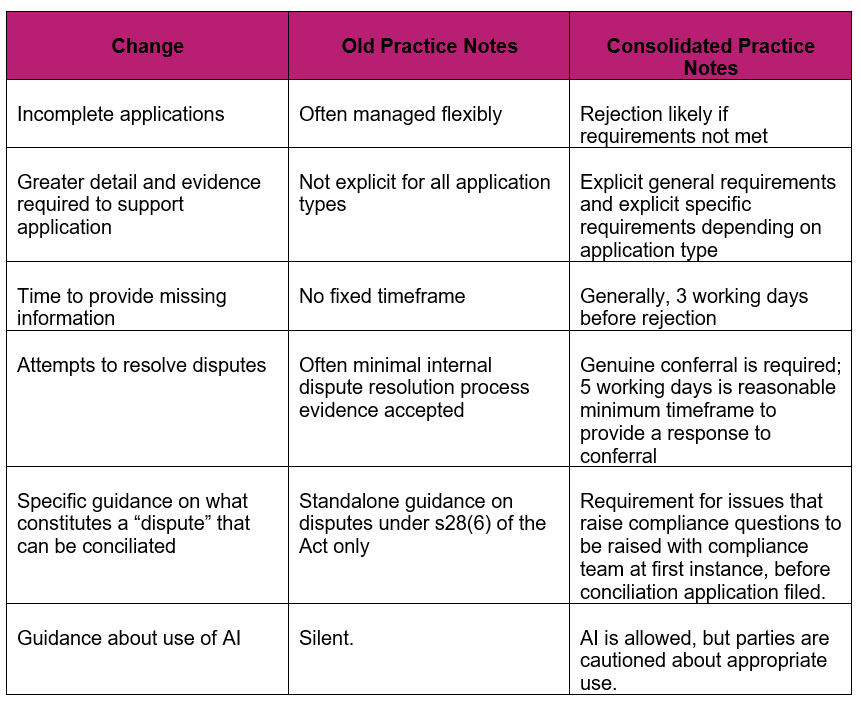
Increased level of detail required for application be “complete” – and reduced tolerance for incomplete applications
Previously there was minimal guidance in the Act or Practice Notes as to the information required to be filed with an application - save for some explicit requirements in relation to proof of conferral, claims for medical and health expenses applications, claims for failure to make provisional payments, claims for total and permanent impairment and claims for compensation following the death of a worker.
The Consolidated Practice Notes now explicitly require all applications to be filed with a copy of the claim form, first certificate of capacity and liability decision notice (if applicable). The notes also go into detail about other supporting information and evidence required to be filed for different types of applications.
The Consolidated Practice Notes require a higher level of detail for income compensation and medical expense disputes. Schedules setting out dates and amounts are now expected, and insurers must clearly state what is accepted, what is disputed and why. For medical expenses, applications must now address reasonableness in addition to entitlement. Unclear payment histories or open‑ended insurer positions are therefore more exposed at conciliation.
There is too much detail in the notes to summarise the requirements for each type of application here – suffice to say it is important that it is important to consult the notes and use it as a checklist of the information and evidence that must be available before an application can be considered.
Under the revoked Practice Notes, incomplete applications were sometimes addressed flexibly after lodgement.
The Consolidated Practice Notes sharply reduce that flexibility. While the Registry may request missing information, applicants are generally given only 3 working days to provide it. If the information cannot be supplied, the application should be withdrawn and re‑lodged once complete.
Attempts at dispute resolution must be genuine, not procedural
The requirement to show attempts to resolve disputes existed under the old Practice Notes, but the new notes take a firmer approach. Evidence must now demonstrate genuine conferral about the substantive issue in dispute, including articulation of each party’s position. The Practice Notes also now identify 5 working days as a generally reasonable minimum time for a response to conferral.
Brief or template internal dispute resolution responses that do not deal with the issue raised (eg. that just say “the original decision is upheld” without explaining why, especially if new evidence is received from the worker) are less likely to satisfy the requirement for genuine conferral.
Disputes that can be conciliated
The notes now give guidance about the types of issues that constitute a “dispute” under the Act and can be conciliated, and those which are appropriate for referral to the compliance team in the first instance.
One example is where payments are not made by an insurer after the insurer has failed to provide a deferral notice in time. The notes make it clear that this should be addressed with the Workcover compliance team at first instance, and can only be raised as a “dispute” after the compliance team and has been notified (and a response has been received).
Use of AI
The use of AI is not banned or limited and no specific disclosures are required. Parties are referred to the Supreme Court of Western Australia Guidelines for the use of generative AI for guidance on appropriate use of generative AI.
Takeaway for insurers
The Consolidated Practice Notes significantly narrow the margin for error once a dispute arises. Clear decisions, timely notices, meaningful internal review responses and complete records now play a decisive role in whether disputes resolve early, are rejected outright, or proceed to conciliation under increased scrutiny.
Have you missed an edition of The CompACT? Download the full series e-book providing a single, practical resource, tracking the key reforms under the Workers Compensation and Injury Management Act 2023 (WA) and how the regime has evolved over time.