The Federal Court has recently delivered a significant judgment in ACCC v Coles Supermarkets Australia Pty Ltd [2026] FCA 598, finding that Coles engaged in misleading conduct in connection with its well-known “Down-Down” pricing campaign.
At the time, many consumers were perhaps more focused on the television ad’s slightly awkward but enthusiastic performance from Status Quo - who had reworked their original song lyrics to “down down, prices are down”.
Given the scale of the campaign, one might speculate that Coles Supermarkets Australia Pty Ltd was under some pressure to recoup the apparent expense of flying the band to Abbey Road Studios… Although, according to the ACCC’s submissions, consumers perhaps ended up contributing more to that effort than they realised.
In any case, the recent judgement handed down by the Honourable Justice O’Bryant’s judgement provides important guidance for businesses using “was/now” pricing and comparative price promotions across all sectors.
KEY FINDINGS
The Court held that Coles contravened the Australian Consumer Law by making misleading representations about price discounts, breaching both:
- section 18 (misleading or deceptive conduct); and
- section 29 (false or misleading representations).
The case focused on Coles’ Down Down campaign for the period commencing February 2022 to May 2023. Central to the campaign was the use of “was/now” pricing, by which the Down Down promotional price was compared to an earlier higher price.
Why was the Down Down promotion misleading?
The pricing strategy Coles used for the products discounted for the Down Down campaign was:

In its Concise Statement, the ACCC alleged that, in respect of each of the relevant products, the information displayed on the Down Down ticket for the product represented to consumers that the product’s “Now Price” was a genuine discount from the price “the product was ordinarily offered for sale for a reasonable period prior to the promotion”. The ACCC further alleged the discount representations were false or misleading because:
- Coles had increased the “Was Price” for only a relatively short period of time (referred to as the “price spike period”) prior to placing the product on the Down Down promotion at the “Now Price” and, in most cases, advertising that higher price as the relevant “Was Price” on the product’s Down Down ticket; and
- the “Now Price” offered during the Down Down promotion was equal to or higher than the “Regular Price”.
To illustrate, the promotional tickets displayed:
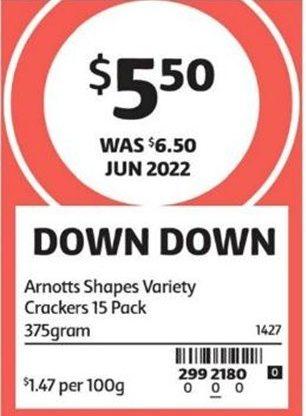
- “Down Down” branding;
- A prominent current price; and
- A smaller “Was $X [month/year]” comparison price.
While the “Was Prices” were genuine in the sense that products were sold at those prices, the Court found the problem was whether those prices were properly “established” as the ordinary price in the market.
Was there a “genuine discount”?
A central issue was what consumers understand by a “genuine discount”. Justice O’Bryan held that the key question is whether the representation creates a real impression of savings, rather than artificial or illusory discount.
The Court accepted that, in most cases, the ticketed “Was Prices” were not artificially fabricated because the products were in fact sold at those prices in real volumes at a previous point in time.
However, the court found that despite this, the issue at hand was whether the price had been sufficiently ”established” in the marketplace such that consumers would regard it as the product’s ordinary price.
In other words, neither a “Was Price” nor a “Now Price” is inherently artificial merely because it is temporary. Rather, where the period during which a product is offered at the “Was Price” is too short to establish it as a genuine pre-promotion selling price, the resulting comparison may render the “Now Price” misleading.
O’Bryan J: “The vast majority of ordinary consumers, when shopping, would not have formed any conscious belief about the period for which the product had been offered for sale by Coles at the ‘Was’ price, beyond an intuitive sense that the discount being promoted was genuine and not artificial.”
What period of time properly “establishes” a price?
The Court accepted the ACCC’s submission that, for a comparative pricing promotion to be genuine, the higher “Was Price” needed to have been established over a period of weeks before the promotion commenced. Otherwise, consumers may be misled into believing that the promotional “Now Price” represents a meaningful discount from an ordinary “Was price” that had not, in fact, been available for a sufficient time.
As part of its submissions, the ACCC tendered an expert report graphing the prices at which Coles offered the relevant products for sale between January 2021 and May 2023. In particular, the graph for Coles Quince Paste illustrates the insufficient “establishment” period prior to the commencement of the relevant promotional pricing:
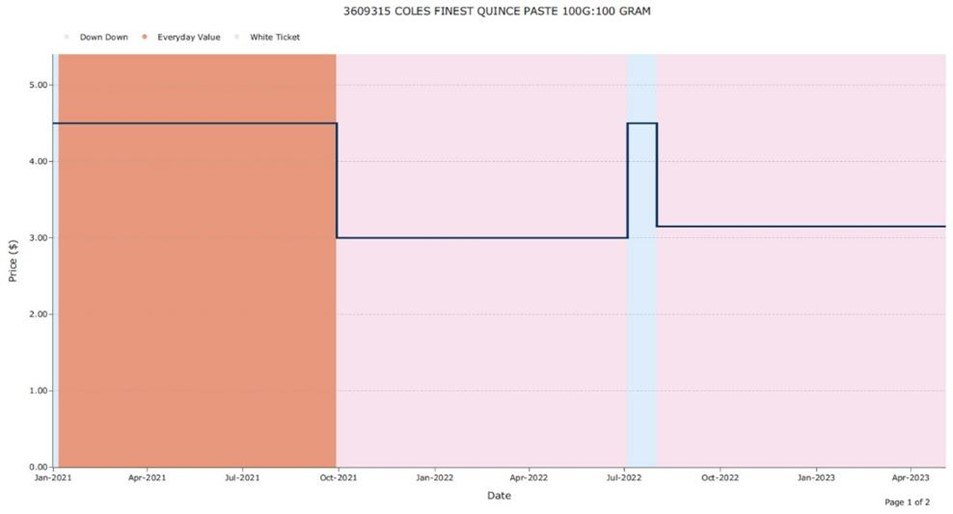
Importantly, the Court provided guidance on the factors relevant to determining what may constitute a sufficient period for prior price to be “established”. In the context of manufactured and packaged grocery products sold in large supermarket settings, this period was indicated to be approximately 12 weeks. While Justice O’Bryan acknowledged that this period should not be applied as a rigid rule, his Honour’s judgement demonstrates that a court is likely to consider the ordinary consumer’s expectation of reasonable price stability within the relevant retail context.
What was not considered to be misleading?
Of all the discounted products considered, one “Down Down" ticket was not found to have conveyed the same discount representation as the others and therefor was not misleading in contravention of the Australian Consumer Law.
This was the Down Down ticket for Nature’s Gift Dog Food, which offered the product at the “Now Price” of $4.50 (bargain!) but the ticket did not include a “Was Price”.
This reinforces that liability depends upon the actual representation made about what pricing was or is now, not simple branding or promotional language.
KEY TAKEAWAYS
The decision provides important guidance for businesses using comparative price promotions across all sectors.
Businesses relying on comparative price claims should ensure that:
- prior prices are genuine and properly established;
- they avoid short-term price inflation before promotions;
- focus on the overall impression conveyed to ordinary consumers; and
- review promotional pricing practices and internal controls to ensure they align with ACCC expectations.
Jackson McDonald’s commercial and consumer law experts can assist your business with ACL compliance, marketing reviews and responding to ACCC investigations.
To discuss your approach to sales advertising or regulatory risk, please contact Ariel Bastian, Elizabeth Tylich or Luke O’Callaghan.
This article was written by, Tegan Hill Lawyer Corporate Commercial.